SYS // WOODHOUSEONLINE
WOODHOUSE
PRIVATE HOUSEHOLD INTELLIGENCE
ROCHE RESIDENCE
MEMORY COREONLINE
IDENTITYAPPLE
REASONINGONLINE
PRIVATE HOUSEHOLD INTELLIGENCE
ROCHE RESIDENCE
SYS // WOODHOUSE · PRIVATE HOUSEHOLD INTELLIGENCE
Woodhouse runs the Roche household: two homes, six people, a split-flap board, a pool, the thermostats, the gate, the cameras, the TV — through one assistant that remembers. Say it in chat, say it out loud, tap it on your phone, or let a rule do it when you pull into the driveway.
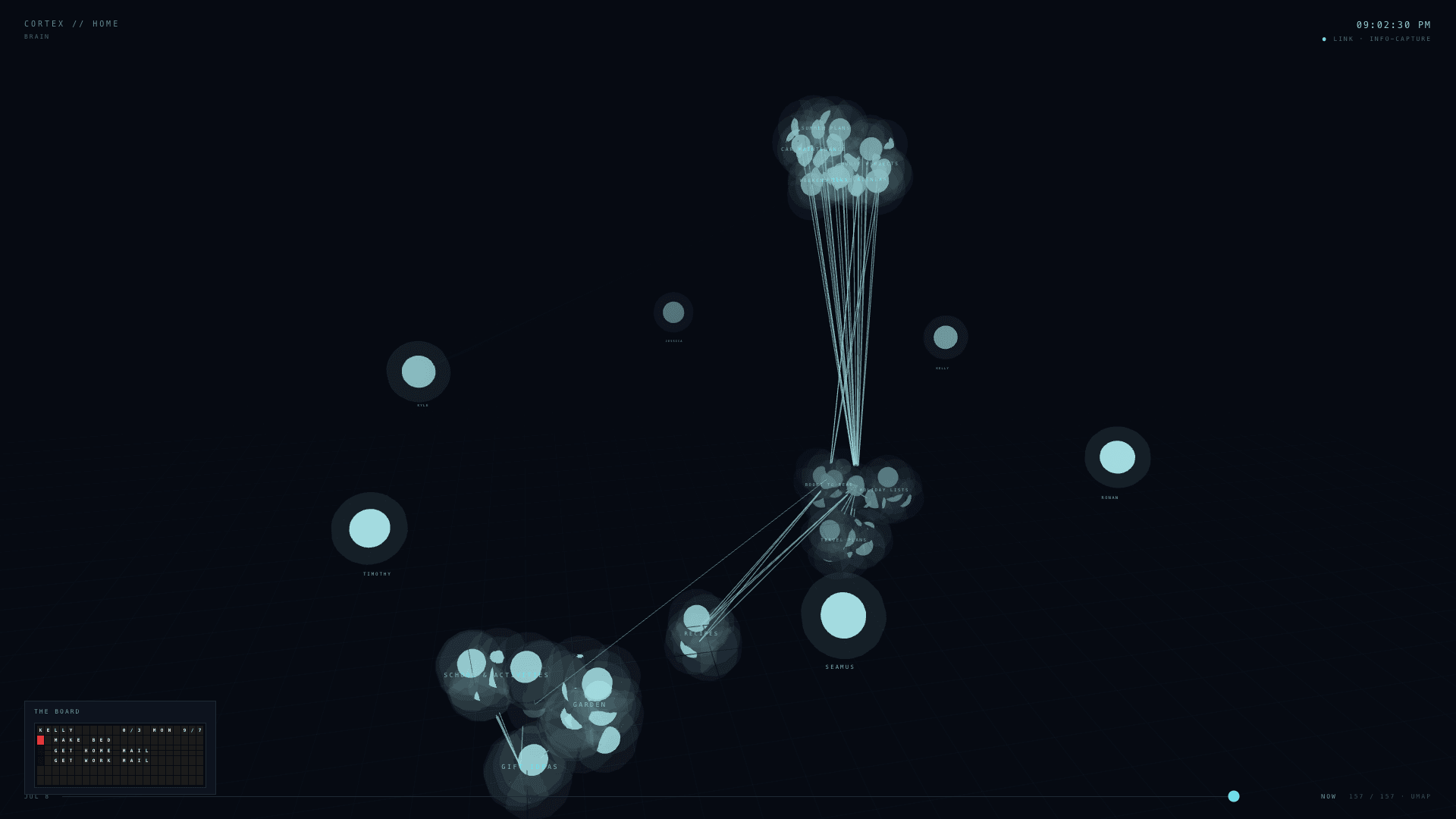
Cortex · the living-room TV · the house's memory, drawn as a constellation
01 · Talk to the house
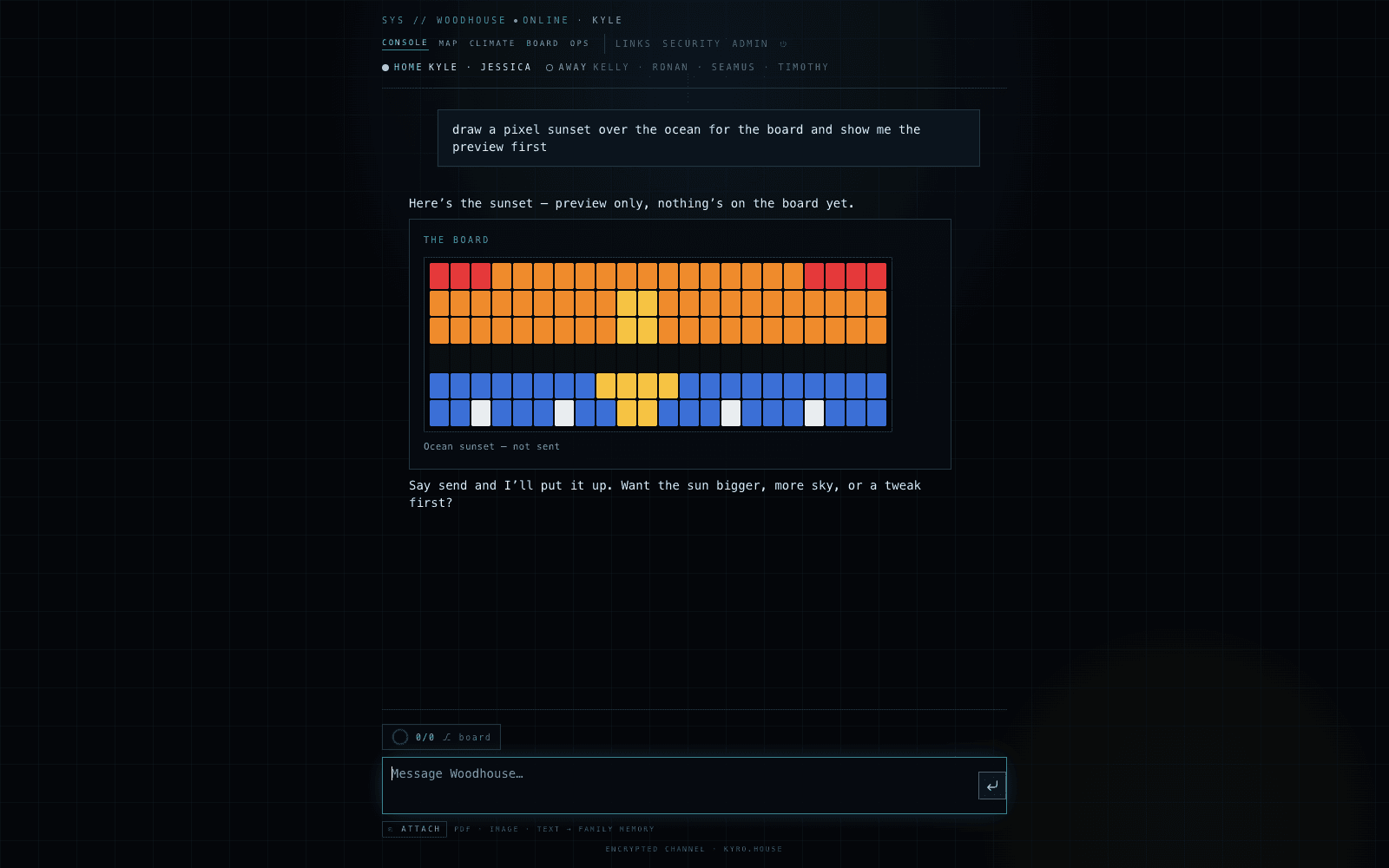
One assistant, every surface
Web, iPhone, iPad, Mac, voice, Siri Shortcuts. Same session, same memory: ask in the car, continue on the couch.
Generative UI
Woodhouse renders what it means — a day schedule, a chore ring, a board preview, a device card — and the app draws the same card natively.
Lock-screen decisions
“Can I go out after school?” arrives as YES / NO. A dinner time proposal arrives as ACCEPT, with Woodhouse having already checked both calendars.
Latency you notice
The owner runs on the newest Grok the AI Gateway offers, tuned for first-token speed; the physical board, the pool and the thermostats respond in about a second from the app.
Reflexes, no model at all
“Poles off.” A short command that plainly names a light, a scene or a routine is matched by Jev — a decision model that answers in a third of a second and writes no prose — and runs directly. Anything with a question, a time or a second step goes to Woodhouse as usual; the gate never runs this way.
02 · The brain
Durable sessions
Every conversation is a durable run: reconnect from the phone, the Mac, or the TV and the turn is still there.
Tools, skills, extensions
Forty-odd tools behind one permission manifest. The board is a proper eve extension; the pool, the gate, the cameras are tools with role gates and owner notifications.
Memory that belongs to people
An LLM-wiki in Neon Postgres + pgvector: raw sources, compiled notes, links. Private by default; a child's proposal to shared memory waits in a parent's review queue. Shared notes can be published one way to a FalkorDB graph the owner's work agents use; nothing flows back.
Honest models
Owner → latest Grok via the AI Gateway. Family → Grok 4.3, reasoning chosen per turn by Jev (about a second for simple requests). Board art → GPT-5.5 (it won an eight-model bake-off). Kids' coding → GPT-5.4. Voice → Grok speech. The catalog decides, not a hardcoded slug.
03 · The hands
Any Mac
The site agent is a native menu-bar app: Keychain token, sandboxed, outbound-only. Point it at a house and it becomes hands for that LAN.
DGX Spark
A 24/7 gateway per house: direct RPC for the cloud, Sonos and thermostats and the pool on the LAN, and an edge build of Woodhouse on a local model.
Fails soft
Gateway first, Neon mailbox second. If a house goes dark, Woodhouse says so and tells you when it last heard from it — it never guesses.
04 · The board
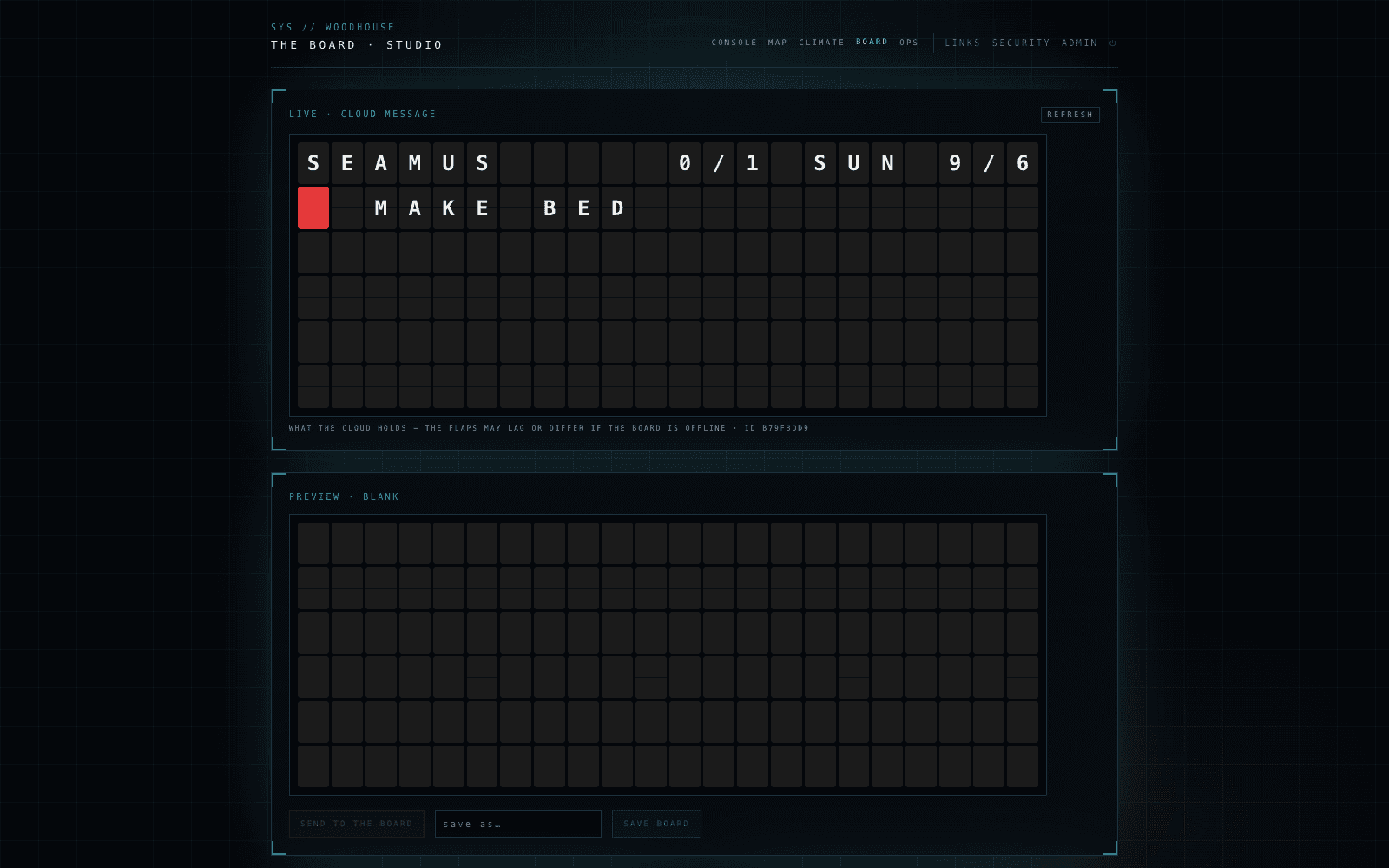
Live boards
Chores (a tile per task: green done, black not yet, red late), today's calendar, who's home, the points leaderboard — rendered from house data the moment you ask.
Artwork
GPT-5.5 paints 6×22 pixel art from the eight tile colors; Woodhouse shows the preview in chat and sends nothing until you say so.
Saved boards
Name one and anyone in the family can put it up — “the welcome board”, “the birthday board”.
An eve extension
The board ships as a proper extension: tools, a composition skill, a rate guard, and hooks the host uses to mirror every send to Cortex.
05 · Cortex
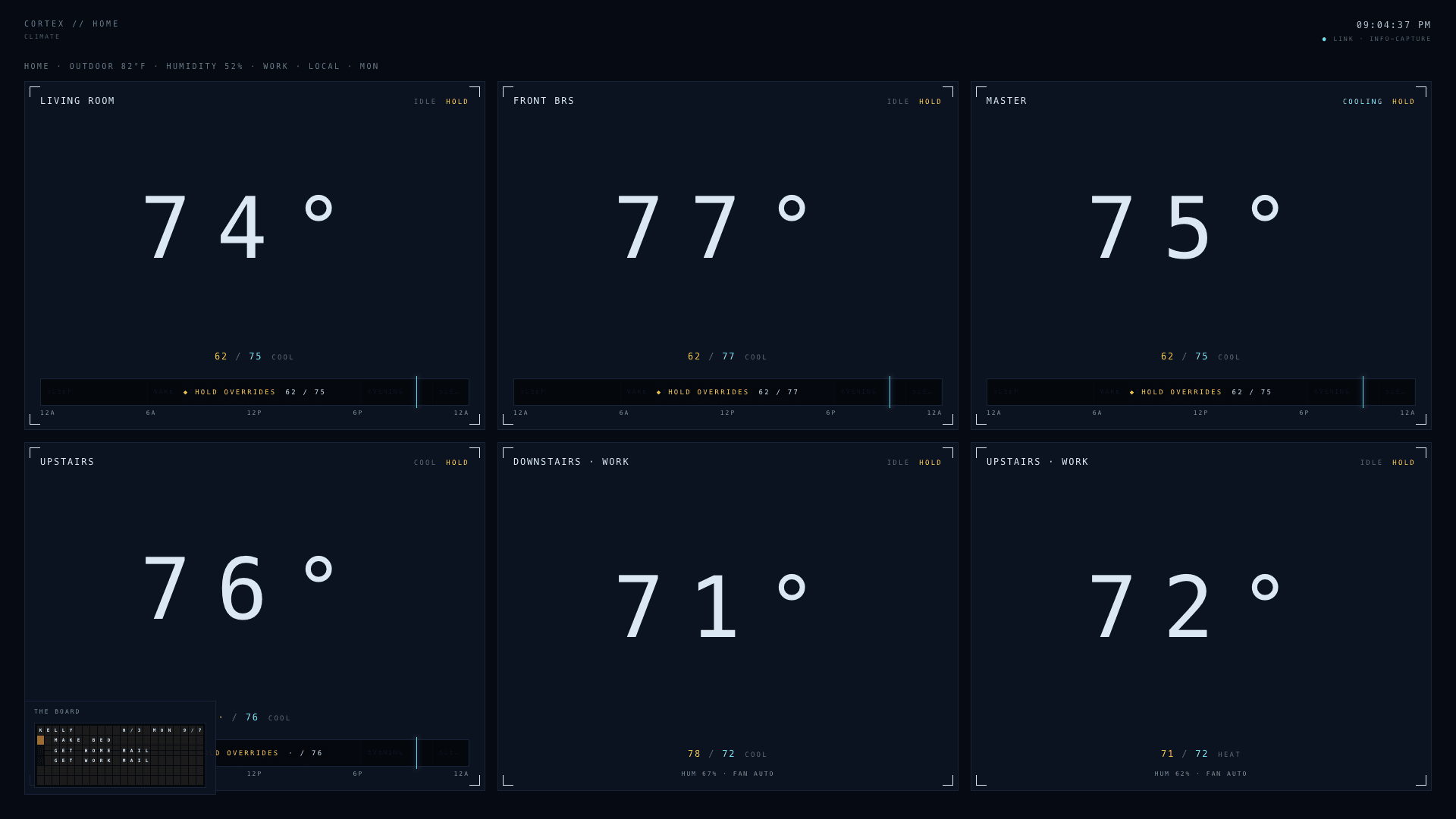
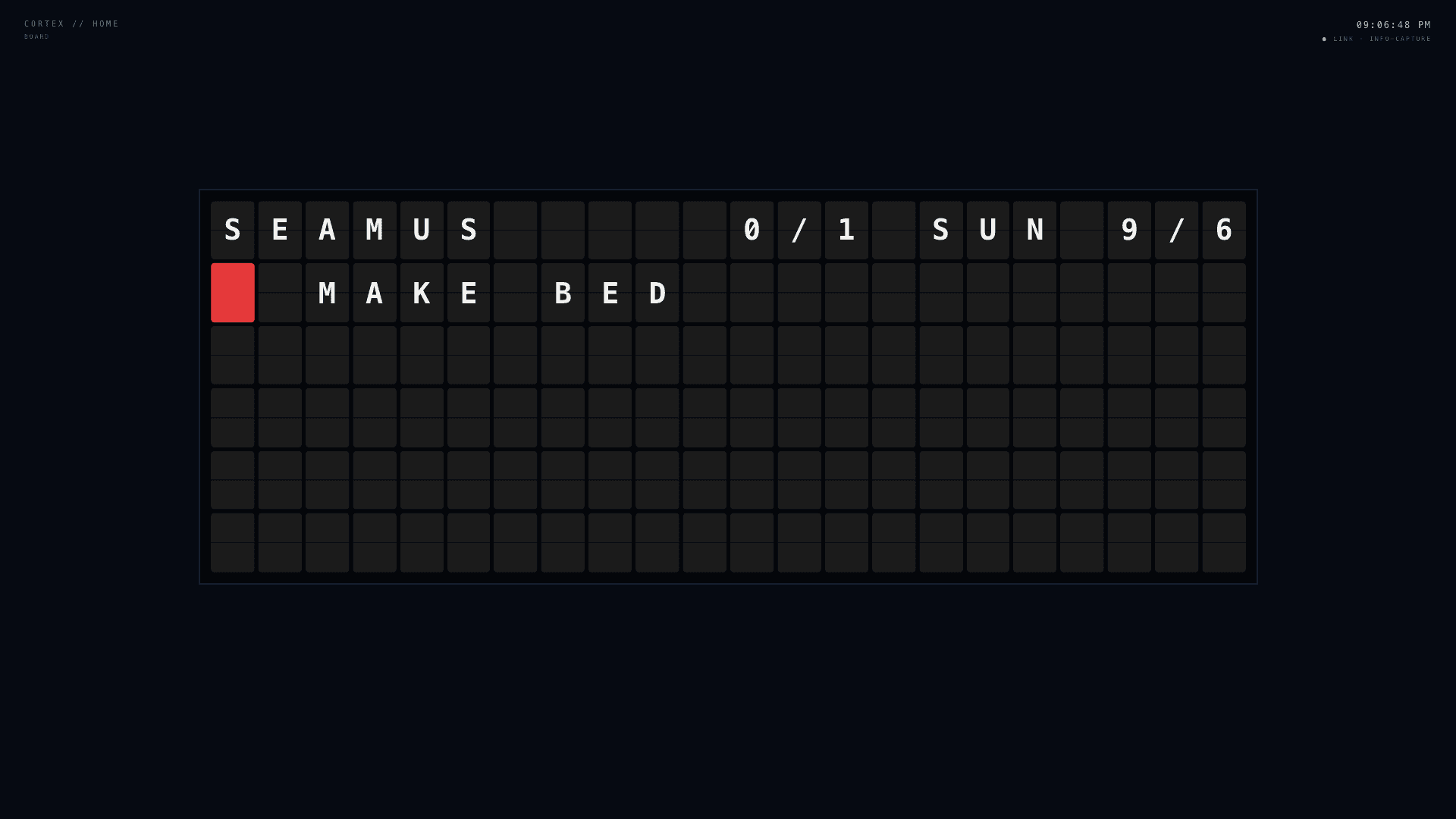
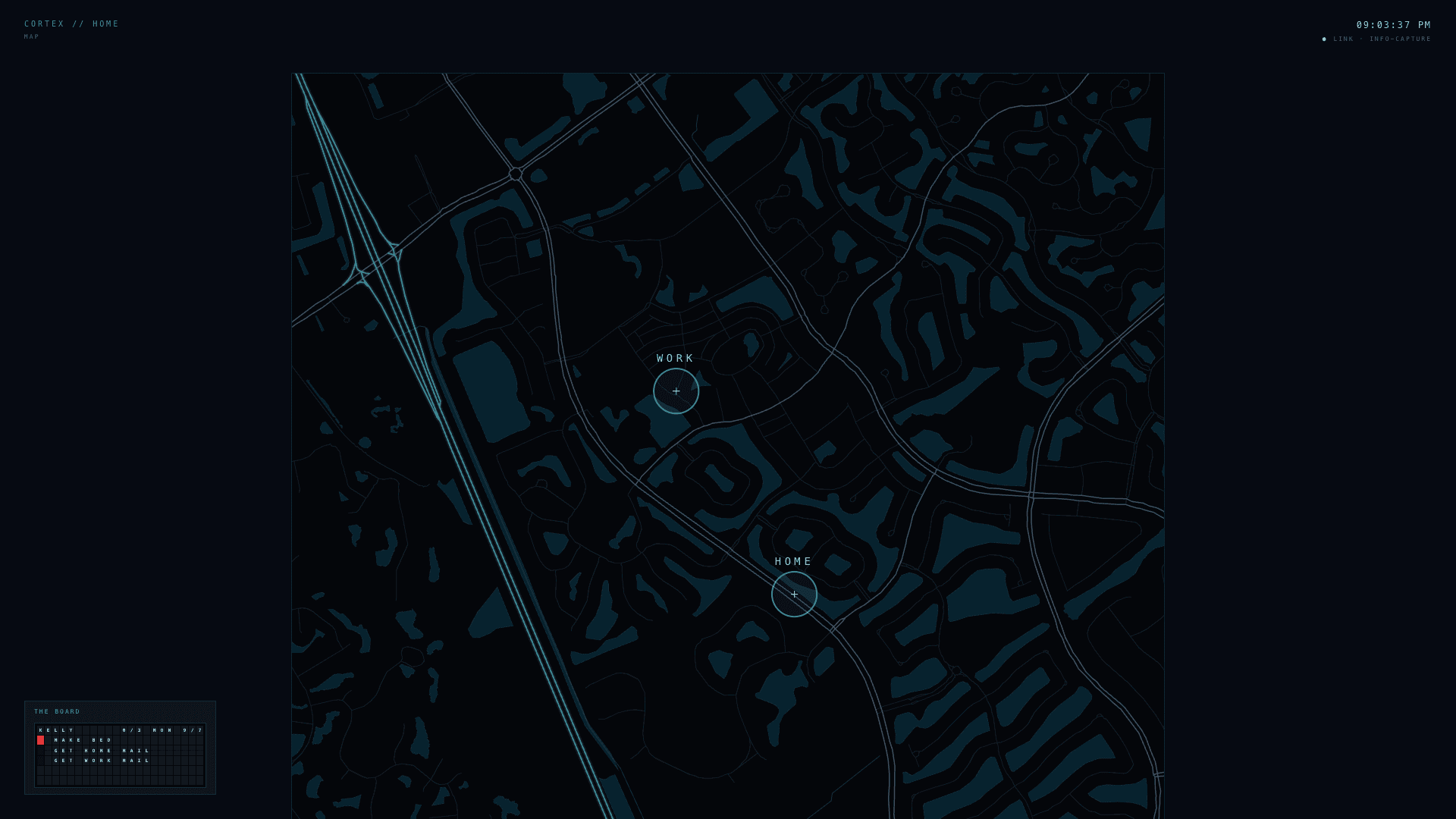
Scenes
brain · climate · cameras · map · board — driven by chat, voice, routines, or Shortcuts.
Latest on the board
Every board change slides in for half a minute, then keeps a small copy in the corner.
Privacy mode
One phrase blanks every screen for guests; the memory scene shows titles on the wall and full text only on your own devices.
06 · The family
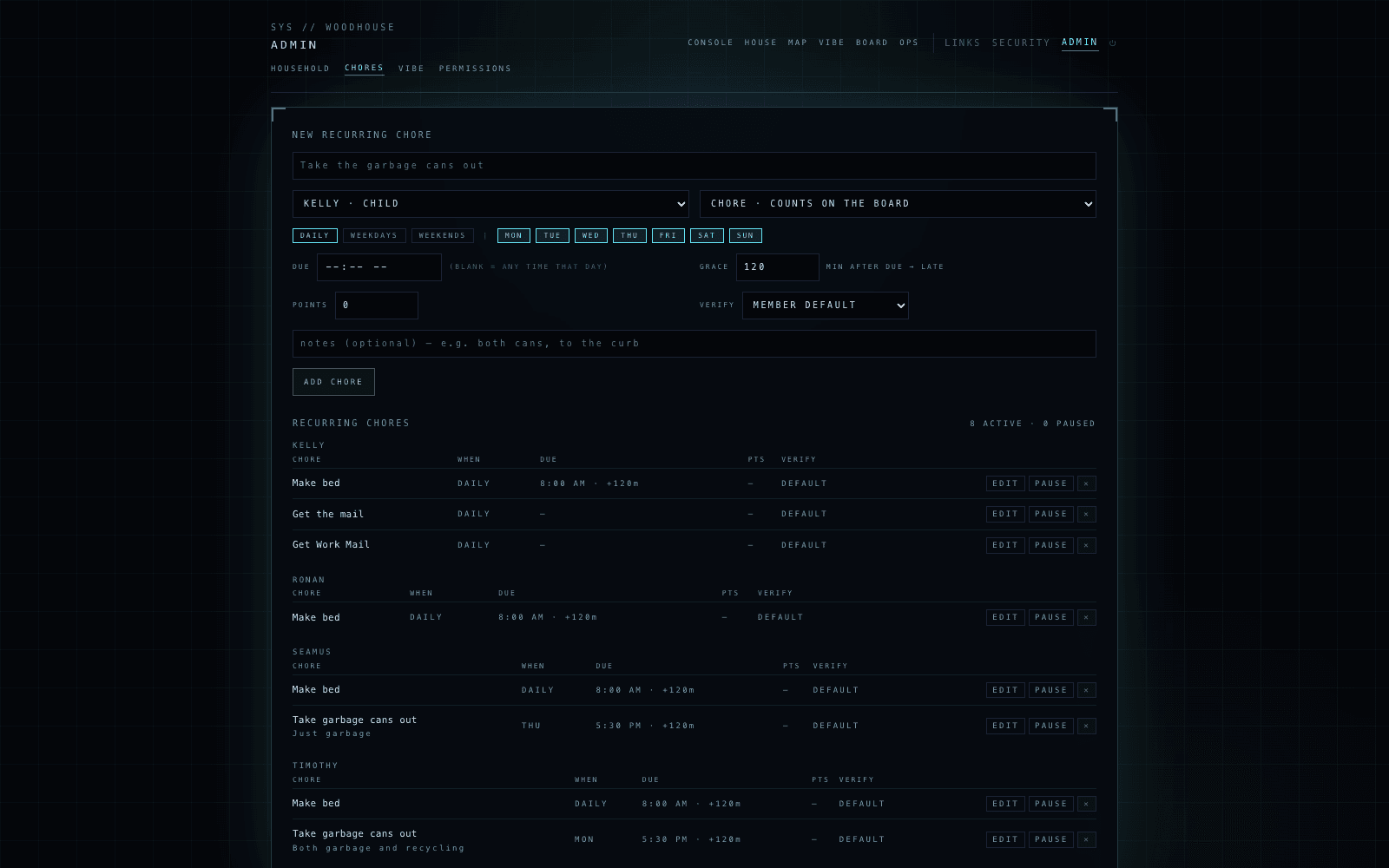
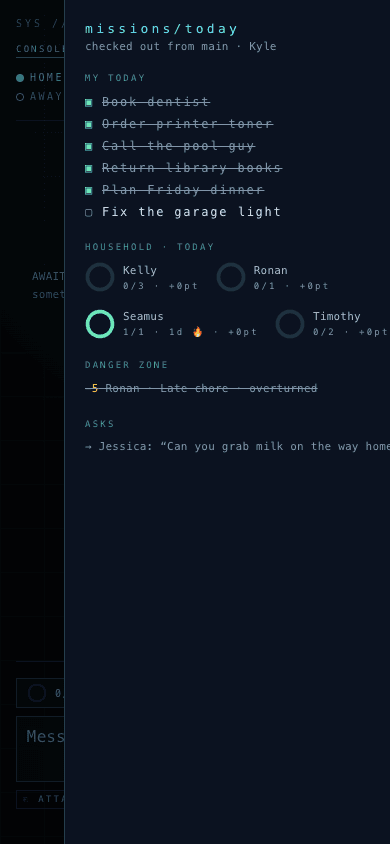
Missions: chores, points, the Danger Zone
Recurring chores with a schedule, verify queues for parents, points and streaks, and a dossier system for docked points — with a photo, a contest, and a way to work it off.
Geofences
Arrive and leave events feed presence, routines, and the map. The house knows who's home without anyone saying so.
A judge, not a nag
After Woodhouse reads an email or a document, anything with consequences used to pause for a yes. Now Jev compares the action with what you actually typed: exactly your words, it runs; anything the outside text could have slipped in, it still asks — and the gate, outgoing mail and admin always ask.
Per-person Google
Calendars and mail are connections, not identity — each member links their own accounts, several if they like.
07 · Automation rules
Triggers
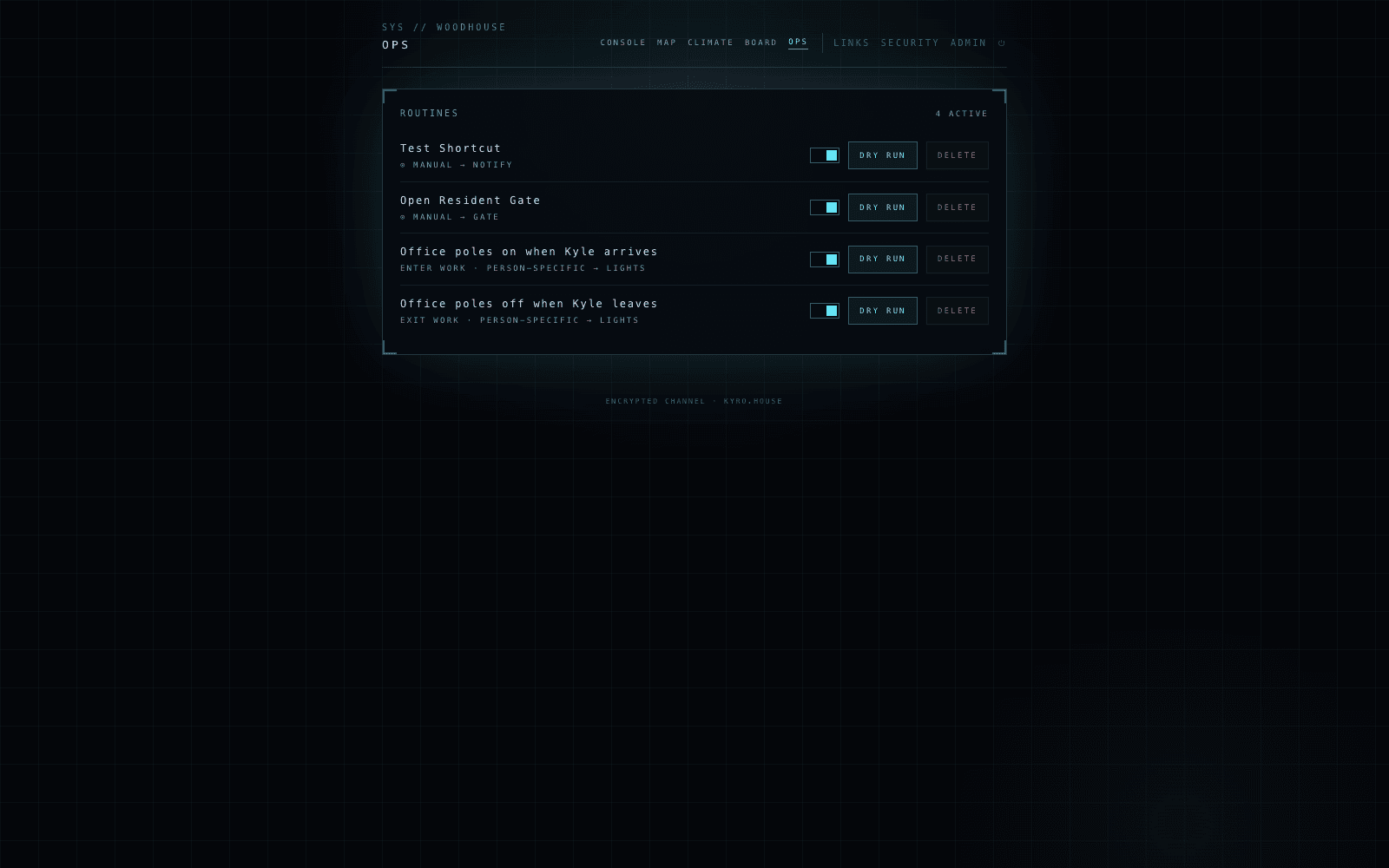
Arrive or leave a site, first person home, last person out, a time on given days, or manual — including Siri Shortcuts.
Conditions
Who's present, who's absent, a time window, a day of the week.
Actions
Notify, Sonos, lights, a delay, the gate (approval-gated), and any Cortex scene on every open screen.
Dry runs
Every routine can be rehearsed: the trace shows each step and what it would have done.
08 · Kids build with it
A whole game first, then small steps
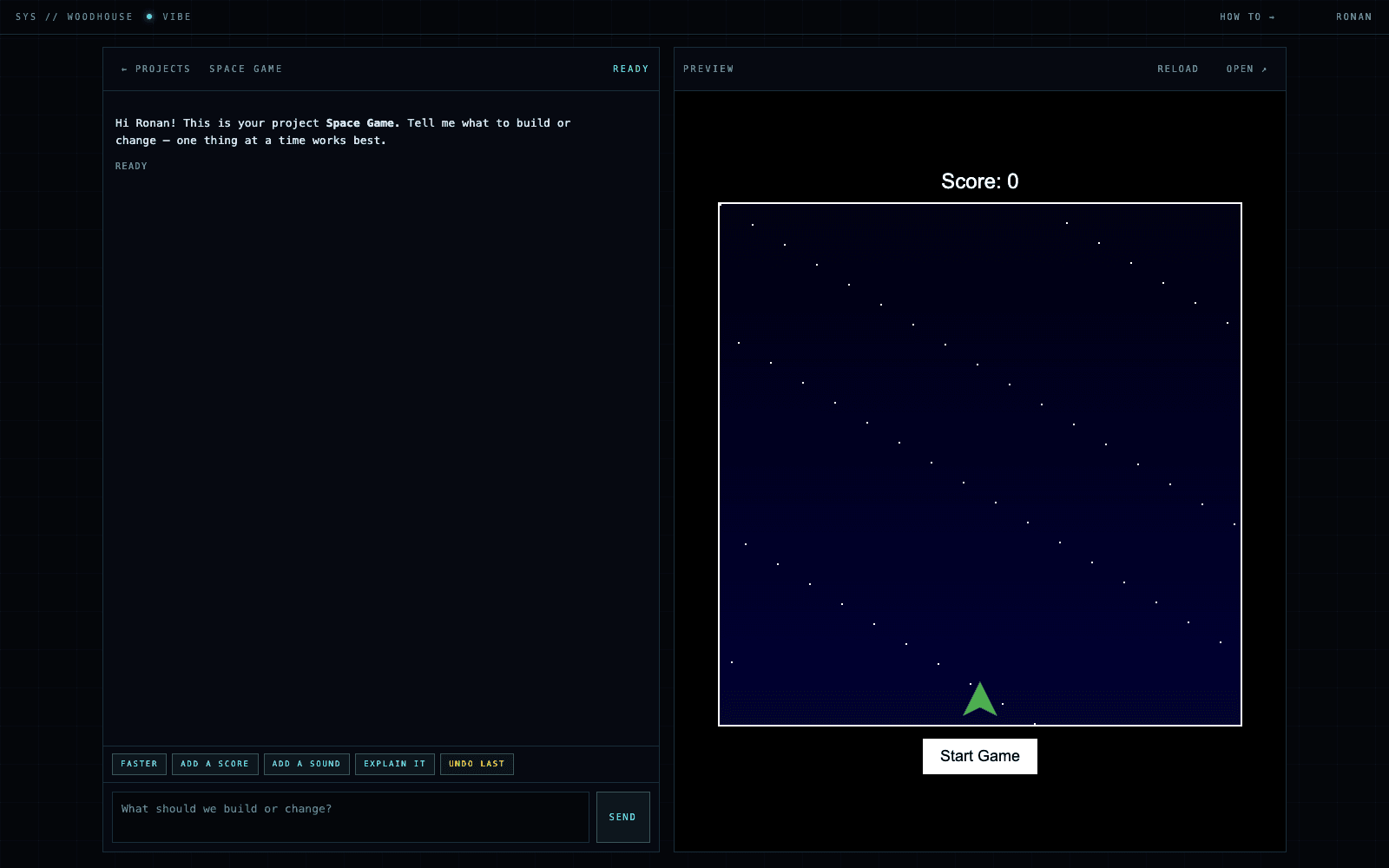
“A ship that dodges asteroids, with a score.” About a minute later it's playable in the preview — controls, collisions, score, game over. “Make the ship faster” edits the same files. Undo puts it back.
Explained, not dumped
The builder never pastes code at a kid. It names one idea per turn — a variable is a labeled box, a loop repeats — and “explain it like I'm not an engineer” walks through the whole game without changing a line.
Sandboxed, family-only
fx is fenced in a throwaway microVM with the project folder as its whole world; games are stored privately and reach the kids only through the family's own sign-in, never a public URL. Publishing to the web is a parent's later decision.
Guardrails a parent set
Plain HTML/CSS/JS only, no network calls, kid-safe content rules the model follows and the house double-checks, every build load-tested (a crash goes straight back to the builder to fix), a middle-school guide with three example games, and per-kid daily, weekly and monthly caps — in builds or in dollars — that a parent sets.
09 · Text it
Approvals are tapbacks
Anything that needs a go-ahead arrives as a text; 👍 approves, 👎 cancels. A child's request needs a parent's thumb; private things asked for in a group wait for the owner's.
Parents steer each group
“Woodhouse, mute this group.” “Only answer me and Jessica.” “Allow the kids.” Parsed in code, no model turn — and the kids are quiet in groups unless a parent says otherwise.
Context without eavesdropping
A group turn carries the last ten messages so “isn't that right, Woodhouse?” has something to be right about; everything else in the thread is never read.
Priced in turns, not texts
Linq bills per line; what each message costs is a model turn. So the gate sits before the turn: unknown numbers dropped, a daily cap for kids, Jev deciding whether an un-named message was meant for him.
10 · Plans
Event pages
kyro.house/events/… — details, Google and Apple calendar buttons, yes/no, a headcount, a bring-list. Family replies from their sign-in; guests prove an email with a six-digit code Woodhouse mails them. The page comes down a day after the event.
Reminders
“Remind me Thursday at 3 to call the dentist” — a one-shot that texts you (or emails you) at the time and then retires itself.
Repeats as one row
“Chores board up every hour from 7 to 9 through Sunday” is a single schedule with a real cron and an end date, shown in words: every hour 7 AM–9 PM until Oct 12.
11 · Devices today
Vestaboard
split-flap board
Trane Link
two-floor HVAC, zoned
Venstar ProStat+
work-house thermostats
Pentair IntelliCenter
pool + spa
Avigilon Alta
neighborhood gate
Blink
cameras
Sonos
whole-home audio, both houses
Govee
lights + office poles
amaran
studio lights
TRMNL
e-ink displays
Samsung Frame
TV art
Brother
printers
Eight Sleep
the bed
eero
the network
Reolinkplanned
PoE doorbell
12 · Open to agents
/llms.txt and /llms-full.txt
The short and the full summary: what this is, what is open, how to set up your own, every env var.
MCP, by invitation
A bot can hand Woodhouse a task over MCP at /eve/v1/mcp with a token the owner mints — the owner's own Grok bot runs this way. Discovery at /.well-known/mcp.json; the public surface in /openapi.json.
CLAUDE.md is the handoff
Locked decisions, hard-won lessons, the permission manifest, the ship rituals — the file a coding agent reads first. STATUS.md says what is tested; USER-GUIDE.md says what the family can do.
Set up your own, in order
Woodhouse runs one household.
Built by Kyle Roche.
Encrypted channel · kyro.house·About·Contact·Developers·Privacy·Terms·llms.txt